Soldier killed in Iraq receives Medal of Honor
His son accepts highest honor from President Bush
Monday, April 4, 2005 Posted: 4:50 PM EDT (2050 GMT)
 | 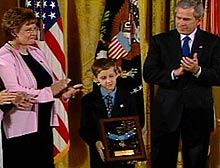 David Smith accepts the Medal of Honor Monday on behalf of his father who was killed in Iraq. |
| |
|  VIDEO |
 Honor given to slain soldier who saved dozens of lives.
|
|
WASHINGTON
(AP) -- Outnumbered and exposed, Army Sgt. 1st Class Paul Ray Smith
stayed at his machine gun, beating back an advancing Iraqi force until
a bullet took his life.
Smith is credited with protecting the
lives of scores of lightly armed American soldiers who were beyond his
position in the battle, on April 4, 2003, near the gates of Baghdad
International Airport.
On Monday, exactly two years after Smith's
death, President Bush awarded him the Medal of Honor, the nation's
highest honor for valor.
"We are here to pay tribute to a soldier
whose service illustrates the highest ideals of leadership and love of
our country," Bush said in a ceremony in the East Room of the White
House.
Bush said Smith "gave his life for these ideals in a
deadly battle outside Baghdad. It is my great privilege to recognize
his great sacrifice by awarding Sgt. Smith the Medal of Honor."
Smith's widow, Birgit, decided that the couple's 11-year-old son, David, would accept the medal on his father's behalf.
"It
was a very easy decision for me because, after all, he's the man of the
house now," she said Monday. She said she often hears from the men her
husband saved, as well as their families. "They're so grateful for what
Paul did that day," she said on ABC's "Good Morning America."
It is only the third Medal of Honor given for actions since the Vietnam War, and the first from the Iraq war.
Smith, 33, was the senior sergeant in a platoon of engineers during the 3rd Infantry Division's northward sprint toward Baghdad.
By
the morning of April 4, elements of the division had reached Baghdad
and captured Baghdad International Airport, a key objective. Encircled
Iraqi militiamen and Special Republican Guard forces inside launched
counterattacks.
Near the eastern edge of the airport, Smith, a
veteran of the first Gulf War, had been put in charge of his unit --
2nd Platoon, Bravo Company, 11th Engineer Battalion -- while his
lieutenant went on a scouting mission.
Smith's mission was
mundane enough -- turn a courtyard into a holding pen for Iraqi
prisoners of war. The courtyard, just north of the main road between
Baghdad and the airport, was near an Iraqi military compound.
Soon
after Smith and some of his platoon began work, records show, one
soldier spotted dozens of armed Iraqis approaching from beyond the
gated walls of the courtyard. Another group of Iraqis occupied a nearby
tower.
Smith summoned a Bradley fighting vehicle, and he and his
troops gathered near the courtyard gate to fight the counterattack. An
M113 armored personnel carrier joined the fray.
The Iraqis,
perhaps as many as 100, attacked with rifles, mortars and
rocket-propelled grenades, or RPGs. Smith threw a grenade over a wall
to drive back some of the Iraqis, then fired a rocket.
Incoming
RPGs battered the Bradley, which retreated. Then a mortar struck the
M113, wounding the three soldiers inside and leaving its heavy machine
gun unmanned.
After directing another soldier to pull the wounded
M113 crewmen to safety, Smith climbed into the machine gun position and
began firing at the tower and at the Iraqis trying to rush the compound.
His upper torso and head were exposed as he manned the gun.
"This
wasn't a John Wayne move," said Command Sgt. Maj. Gary J. Coker, the
top enlisted man in the 11th Battalion, who was near the battle.
"He was very methodical. He knew he had the gate and he wasn't going to leave it and nobody was going to make him leave it."
Still, Coker said, "it was absolutely amazing to stand up in that volume of fire."
During
a stretch of 15 minutes or longer, Smith fired more than 300 rounds as
Pvt. Michael Seaman, protected inside the M113, passed him ammunition.
Then
he was struck by enemy fire and mortally wounded. At almost the same
time, 1st Sgt. Timothy Campbell ended the threat from the tower with a
grenade, and the surviving Iraqis withdrew.
Medics tried to save Smith but he died about 30 minutes later.
He and his comrades were credited with killing between 20 and 50 Iraqi soldiers.
Beyond his position were American medics, scouts, a mortar unit and a command post -- all lightly armed and vulnerable.
"Sgt. 1st Class Smith's actions saved the lives of at least 100 soldiers," according to an Army narrative.
Smith was born in El Paso, Texas, and moved to Tampa, Florida, when he was 9. He enlisted in the Army in 1989.
He
was known for being tough on the men under his command, Coker, who has
returned to Iraq with the 3rd Infantry Division, said in a weekend
telephone interview.
But Smith held himself to the same standard, Coker said, and he took care of his young soldiers when they needed it.
Back in the United States, when one private's wife fell seriously ill, Smith drove four hours to bring toys to their children.
The
other two post-Vietnam Medals of Honor went to Army Master Sgt. Gary I.
Gordon and Army Sgt. 1st Class Randall D. Shughart, two Delta Force
troopers who died defending the crew of a helicopter that was shot down
in Mogadishu, Somalia, in events depicted in the book and movie "Black
Hawk Down."
More than 3,400 Medals of Honor have been awarded
since the decoration was created in 1861, of which more than 600 have
been given posthumously.
Copyright 2005 The
Associated Press. All rights reserved.This material may not be published, broadcast, rewritten, or redistributed.