New pope keeps old guard for now
Thursday, April 21, 2005 Posted: 12:30 PM EDT (1630 GMT)
 | 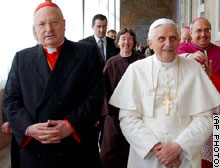 Benedict XVI takes a tour of the papal apartments with his No. 2, Cardinal Angelo Sodano (left). |
| |
|
 VIDEO |
 Pope's past offers clues to future of papacy.
 A look at the many facets of the global Catholic Church.
 The new pope receives mixed reaction around the world.
|
|
VATICAN
CITY (AP) -- Pope Benedict XVI confirmed Cardinal Angelo Sodano in the
Vatican's No. 2 post Thursday and kept all other top officials,
avoiding any immediate shake up in the late John Paul II's
administration.
It was a sign that the new pope, a doctrinal hard-liner, wants to show continuity with the popular John Paul.
Later
Thursday, Benedict made another stop at his apartment across the street
from the Vatican walls. He arrived in a car and waved at several
hundred people waiting outside for a glimpse of him before he entered
the building.
Benedict has not yet moved into the papal
apartments overlooking St. Peter's Square, staying instead at the
Vatican hotel where cardinals slept and dined during the conclave that
elected him Tuesday.
Sodano, the Vatican's secretary of state, is
77, already two years past the normal retirement age for Vatican
officials. The new pope is 78.
One appointment Benedict will have
to make is his successor as head of the Congregation for the Doctrine
of the Faith, the Vatican's guardian of orthodoxy.
Among names
that have surfaced as possible successors are Cardinal Christoph
Schoenborn of Austria and Cardinal Francis George of Chicago.
The
Vatican also said the pope confirmed the Holy See's foreign minister,
Archbishop Giovanni Lajolo of Italy, as well as the undersecretary of
state, Archbishop Leonardo Sandri of Argentina, who had become John
Paul's official voice when the late pontiff could no longer speak.
The
confirmation of Sodano came a day after Benedict gave his first Mass as
pope, pledging to keep reaching out to other religions and leaving no
doubt that he senses the large shadow of his predecessor.
"I seem
to feel his strong hand holding mine, I feel I can see his smiling eyes
and hear his words, at this moment particularly directed at me: 'Be not
afraid,"' said Benedict, who until Tuesday was simply Cardinal Joseph
Ratzinger.
While signaling that he wants to tread in John Paul's
ideological footsteps, the pope is a contrast in style to his
predecessor, who was 20 years younger when he became pontiff and kept
up a grueling global travel schedule even as his health ebbed.
John
Paul II, who died April 2, acted, played soccer, went canoeing in
mountain streams as a young man in Poland. Benedict is mostly an indoor
man, though he is a big walker because of his youth in the Bavarian
Alps. He finds relaxation in classical music and likes to play the
piano, not take to the stage.
But the Vatican also showed that
Benedict intends to follow in the footsteps of John Paul's multimedia
ministry. It modified its Web site so that users who click on an icon
on the home page automatically activate an e-mail composer with
Benedict's address. In English, the address is benedictxvi@vatican.va.
Benedict
took a cue from John Paul when he pledged Wednesday to work for unity
among Christians and to seek "an open and sincere dialogue" with other
faiths.
He also stressed he would draw on the work of the Second
Vatican Council, the 1962-65 meeting that modernized the church, an
issue important to liberals who are wary of Benedict from his time as
the powerful enforcer of church doctrine.
Benedict will be
fighting that reputation close to home as he tackles one of the biggest
challenges: a Europe of empty churches and growing secularism.
And
as the world's 1.1 billion Catholics got first hints of where the
papacy is headed, followers of other religions weighed the future of
interfaith relations. By and large, reactions were hopeful and
expectant -- an indication of the new standards in reaching out that
John Paul set during his 26-year papacy.
"I think he has been
very open, so I have no worries about the ecumenical route," said
British Cardinal Cormac Murphy-O'Connor. "It will continue. No doubt at
all."
But Benedict has been one of the most forceful Vatican
voices for Catholic missionary work and other forms of evangelization.
He was the intellectual driving force behind the 2000 document "Dominus
Iesus," which outlined the idea that divine truth is most fully
revealed in Christianity and the Catholic Church in particular. The
decree angered Protestants, as well as Jews, Muslims and other
non-Christians.
In Israel, admiration for John Paul's tireless
efforts to promote Jewish-Catholic reconciliation mixed with unease
about Benedict's time in the Hitler Youth as a teenager.
Benedict
has written openly about his service, which was compulsory under the
Nazi regime. He also was drafted into a German anti-aircraft unit
during World War II, though he says he never fired a shot.
John
Paul won many Israeli hearts during a trip to the Holy Land in 2000 by
apologizing for Roman Catholic wrongdoing over the centuries. He also
was praised for promoting interfaith dialogue, establishing diplomatic
relations with Israel and aiding Polish Jews during the Nazi era.
"Israel
can certainly coexist with him," Oded Ben-Hor, Israel's ambassador to
the Vatican, said of the new pope. "But the real test will come over
the course of time."
Benedict inherits sometimes testy relations
with the Russian Orthodox Church, which has accused Catholics of
poaching Orthodox believers. John Paul, the first Slavic pope, saw a
visit to Russia as a way to promote greater Christian unity a
millennium after the east-west schism, but he never was able to arrange
the trip.
"We very much hope that under the new pope those problems will be solved," said Igor Vyzhanov, an Orthodox church spokesman.
Benedict's
election was welcomed across the Islamic world, where many people hope
he will promote harmony between the two religions and possibly Middle
East peace.
The new pope won praise from Muslims by criticizing
Italian Prime Minister Silvio Berlusconi for comments in 2001 that
Western civilization is superior to Islam. "One cannot speak of the
superiority of one culture over another, because history has shown that
a society can change from one age to another," he said at the time.
But
Benedict has objected mostly Muslim Turkey's bid to join the European
Union, viewing it out of line with the continent's Christian traditions.
John
Paul was the first pope to visit a mosque, urged religious tolerance,
spoke out against the U.S.-led war in Iraq and called for a peaceful
end to the Arab-Israeli conflict.
Given John Paul's tireless
traveling to promote both Catholicism and interfaith dialogue,
Benedict's impact will depend on his health, vigor and the ability of a
relatively shy man to captivate crowds.
He himself predicted a
"short reign" in comments to cardinals just after his election, and his
brother worried about the stresses of the job on a man Benedict's age.
While
there are no indications that Benedict suffers from any serious or
chronic medical problems, he has had ailments -- including a 1991
hemorrhagic stroke -- that raise questions about how long his
pontificate will last.
The Vatican refused to comment on
Benedict's health, citing his privacy. The Vatican never officially
confirmed that John Paul suffered from Parkinson's disease until after
he died.
The pope's immediate schedule includes a meeting with
cardinals Friday, a news conference Saturday and his inauguration
service Sunday. On Monday, he will visit the tomb of St. Paul at
Basilica of St. Paul's Outside-the-Walls, the Vatican said.
Copyright 2005 The
Associated Press. All rights reserved.This material may not be published, broadcast, rewritten, or redistributed.