Some defining moments of CNN's first 25 years
Wednesday, June 1, 2005 Posted: 8:53 PM EDT (0053 GMT)
 | 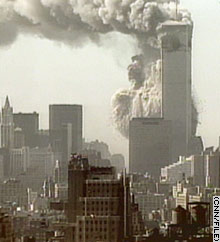 One of the most defining moments from the past quarter century is the September 11, 2001, attacks. |
| |
|  VIDEO |
 Watch highlights from CNN's first hour of broadcasting in 1980.
|
| DEFINING MOMENTS | Anita Hill testimony
Baby Jessica's rescue
Black Monday on Wall Street
Clinton-Lewinsky scandal
Columbia/Challenger disasters
Columbine school shootings
Fall of Berlin Wall, communism
Florida recount in 2000 election
Genocides in Rwanda, Bosnia
Gulf wars
John F. Kennedy Jr.'s death
Los Angeles riots in 1992
Nelson Mandela's freedom
O.J. Simpson trial
Oklahoma City bombing
Osama bin Laden
Pennsylvania miners' rescue
Princess Diana's death
Reagan's presidency and death
September 11 attacks
Tiananmen Square
Tsunami devastation
Waco stand-off
William Kennedy Smith trial
World Series earthquake
|
|
(CNN)
-- Since first signing on the air June 1, 1980, CNN has reported on an
ever-changing world, shaped by events of great tragedy and triumph. To
mark the quarter-century anniversary, CNN looks at some of the moments
and people that define history over the past 25 years.
One of the first milestones of the 21st century began as a sunny day. But September 11, 2001,
ended with the deaths of more than 2,700 people in the worst terrorist
attack in U.S. history. Four planes hijacked by terrorists crashed into
the World Trade Center, the Pentagon and a field in Pennsylvania in a
plot officials say was organized by al Qaeda leader Osama bin Laden. (Reader's poll: Weigh in on the top stories)
Over
the course of the day and weeks to come, the world followed the
developments and investigation, as well as heartbreak, as personal
accounts emerged from the national tragedy.
"What happened to our
nation on a September day set in motion the first great struggle of a
new century," President Bush said at a memorial service in Washington,
a year after the attacks.
Six years earlier, the world had
learned of another building severly damaged and lives lost after a
deadly bombed ripped through the Alfred P. Murrah Federal Building in
downtown Oklahoma City, Oklahoma
Decorated Gulf War
veteran Timothy McVeigh was convicted of planning the attack and
detonating the bomb, and was executed in June 2001. McVeigh's ex-Army
buddy, Terry Nichols, is serving multiple life sentences on federal and
state charges for assisting in the crime, and a third man, Michael
Fortier, was sentenced to 12 years in prison for not warning
authorities about the plot.
Federal prosecutors theorized that
the Oklahoma City attack was motivated by antigovernment feelings over
the raid on the Branch Davidian compound outside Waco, Texas,
in 1993. The government believed that the religious group, headed by
David Koresh, had stockpiled weapons. A 51-day standoff ended when the
FBI stormed the compound, and a group of buildings caught fire and
burned to the ground, killing some 80 inside.
Haunting stories about ethnic rivalries that exploded into atrocities came out of Rwanda and the Bosnian war.
In
three months of brutal and unrestrained violence in 1994, nearly 1
million people were killed in Rwanda when ethnic Hutus tried to
exterminate moderate Hutus and Tutsis.
"The genocide was brutal,
criminal and disgusting and continued for 100 days under the eyes of
the international community," Canadian Gen. Romeo Dallaire told a
conference marking the 10th anniversary of the slaughter. Dallaire was
commander of a small U.N. peacekeeping force in the African nation when
the genocide began.
Full-scale civil war broke out in Bosnia and
Herzegovina in 1992 between Serbs, Croats and Muslims. As part of an
ethnic cleansing policy by the Serbs, thousands of Muslims were forced
from towns and killed or placed in concentration camps. In Srebrenica,
some 8,000 Muslims were believed killed in a massacre, considered the
worst in Europe since World War II.
Nature delivered destruction in the form of the 2004 tsunami.
The world's most powerful earthquake in more than 40 years struck deep
under the Indian Ocean on December 26, triggering massive tsunamis that
obliterated cities, seaside communities and holiday resorts, killing
tens of thousands of people in a dozen countries.
Another earthquake
that struck in 1989 is one remembered by many -- because they watched
it live on TV. Just moments before a World Series baseball game in San
Francisco -- with millions tuned in -- the quake hit the Bay area,
killing more than 60 people.
Three years later, rioting
erupted in Los Angeles after a majority white jury acquitted four
police officers of the videotaped beating of black motorist Rodney
King. The riots left 55 dead, thousands injured, a billion dollars in
damage, and a wall of distrust between the police and the black
community.
The world mourns
Some events from the past 25 years brought the world together in mourning.
On April 20, 1999, Columbine High School
in Littleton, Colorado, became infamous when Eric Harris and Dylan
Klebold opened fire on fellow students and faculty. By the end of the
day, 14 students, including the shooters, and one teacher were dead.
Millions
of TV viewers watched the aftermath and witnessed the dramatic images
of Pat Ireland, then a 17-year-old junior, hanging out of a
second-floor window to escape.
"I think initially there was some
question as to why, but you just can't focus on that stuff," he told
CNN in 2005. "You've got to get past it and realize that you have your
own life to live and try to make the most of it."
Two painful moments from the past quarter-century reminded us of the vulnerabilities of space flight: the space shuttle Challenger and Columbia tragedies.
Carrying
seven crew members, including high school teacher Christa McAuliffe,
Challenger lifts off January 28, 1986, and explodes 74 seconds later.
Seventeen years later, on February 1, 2003, it was a shuttle landing
that turned tragic. About 15 minutes before its scheduled touch down at
Kennedy Space Center in Florida, Columbia disintegrates in the
atmosphere 40 miles above the Earth. Once again, all crew members are
lost.
Accidents in the 1990s claimed the lives of two almost fairy-tale figures who were beloved by millions. Britain's Princess Diana,
the "people's princess," was killed in a car accident in Paris in 1997,
along with Dodi Fayed and driver Henri Paul. Two years later, John F. Kennedy Jr.,
who had spent his life in the spotlight as a member of America's "royal
family," died in a plane crash with his wife and her sister.
Moments of triumph
Along with the stories of sorrow, the past 25 years also has seen moments that gripped the heart of viewers.
Trapped
in a cramped, flooded chamber deep below the Pennsylvania countryside,
nine miners fought to survive for more than three days in 2002. Above
ground, a community rallied to their aid, despite a mountain of
obstacles, and a nation followed the suspense.
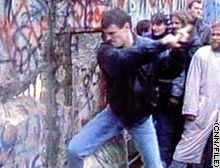 In 1989, crowds destroyed the Berlin Wall, signalling the collapse of East Germany's Communist regime. | |
One by one, all nine soggy and exhausted Quecreek miners, their faces blackened with coal dust, were pulled from the cold and dark hole, met by applause and cheers.
Fifteen years earlier, an infant known as "Baby Jessica" to the world was the subject of another successful rescue.
For
58 hours, crews in Midland, Texas, worked feverishly to rescue
18-month-old Jessica McClure from an abandoned well. Eventually,
paramedics were able to squeeze into a parallel passageway and slide
Jessica out of the narrow shaft 22 feet below the ground and into the
bright glare of television lights.
Two events in 1989 showed the world the power of convictions. Pro-democracy demonstrators in China confronted tanks in Tiananmen Square, with deadly results. The same year, East Germany's Communist regime collapsed and crowds joyfully destroyed the Berlin Wall, the symbol of a Germany divided since World War II.
Nelson Mandela's
life has inspired many who watched him spend much of his life fighting
South Africa's apartheid system. He was in prison 27 years before
attaining his freedom in 1990 and then becoming his country's first
black president.
Inside the battlefield, courtrooms, Wall Street
"Something's happening outside." With those words by CNN's Bernard Shaw from a Baghdad hotel, the world learned that the Iraq war in 1991 had begun and, for the first time, the public could experience the fighting and bombing live.
Operation Desert Storm quickly drove Saddam Hussein's armies from Kuwait, which the Iraqis had invaded months before.
Twelve
years later, U.S. and coalition forces launched attacks against Iraq,
after the Bush administration and its supporters in Congress said
Saddam had kept a stockpile of chemical and biological weapons in
violation of U.N. resolutions. Reporters embedded with troops gave the
public unprecedented live access inside the battlefield as major
fighting unfolded.
In the past 25 years, viewers also have had the ability as never before to go inside the courtroom.
Watching live, the public could follow the daily proceedings in the 1991 William Kennedy Smith trial and tune in as he was acquitted of rape.
And in perhaps the most watched trial of the past decades, all of the world learned of O.J. Simpson's not guilty verdict by the jury at the same time as he did on October 3, 1995.
The world watched on Black Monday -- October 19, 1987
-- as business markets mysteriously tumbled uncontrollably. On that
day, the Dow Jones Industrial Average recorded the largest one-day
decline in history. Over the next weeks, stock markets around the globe
suffered.
Political moments
For most of CNN's first decade, President Reagan
dominated politics, ushering in the modern-day conservative political
movement with two terms in the 1980s. His death in 2004 prompted a
five-day national farewell full of ceremony and somber majesty.
Another president is remembered for the scandal that surrounded him. President Clinton's
relationship with White House intern Monica Lewinsky shocked a nation
and his 1998 impeachment trial -- in which he was found not guilty --
riveted them to their television screens.
Seven years earlier, the public watched Anita Hill
testify during the Senate confirmation hearing of then-Supreme Court
nominee Clarence Thomas. Her sometimes graphic allegations of prior
workplace sexual harassment by Thomas during their employment at the
Equal Employment Opportunity Commission put a spotlight on the issue.
Perhaps the biggest political firestorm ignited in the 2000 presidential election.
After a historic, protracted 36-day legal battle, then-Texas Gov.
George W. Bush became the winner after a Supreme Court ruling on the
Florida vote favored Bush over Vice President Al Gore.