
 |
|
|||
| Member Services |  |
|||
 |
 |
 |
   | 
| ||||||||||||||||||||||||||||||||
Civil war focus of Algerian voteReferendum is aimed at healing divisions
Thursday, September 29, 2005; Posted: 4:50 a.m. EDT (08:50 GMT)
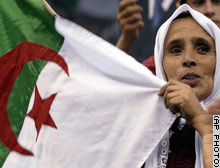 A woman holds an Algerian flag earlier this week at a rally in Algiers for President Abdelaziz Bouteflika. YOUR E-MAIL ALERTSALGIERS, Algeria (AP) -- The cycle of deadly violence and atrocities that gripped Algeria for more than a decade is at the heart of a referendum Thursday that asks: Is it time to forgive and move on? President Abdelaziz Bouteflika says his Charter for Peace and National Reconciliation is aimed at closing the wounds of the battle between Islamic extremists and security forces that left an estimated 120,000 people dead and resulted in thousands of mysterious disappearances. Critics claim the charter is a way for the president to further consolidate power in this North African nation of nearly 33 million and say that, with pardons for many of those who perpetrated the violence, it goes against the very notion of peace. Opponents also object to proposals asking the nation to trust the government to handle cases of people who went missing -- pointing out that government forces are suspected in many of the disappearances. Green, white and red posters promoting the referendum decorated the walls of buildings across Algiers. Television, radio stations and newspapers carried reports on the benefits of making peace with those who have "gone astray." But critics say there has been no forum for a real debate. "The campaign has been monopolized by authorities," said Nour Eddine Benissad, an attorney for the Algerian League for the Defense of Human Rights. "We needed a democratic debate." Bouteflika has crisscrossed Algeria for weeks, addressing rallies to call out the "yes" vote so the nation can reconcile itself with what authorities refer to as the "national tragedy." He asked living victims to accept a "new sacrifice in the interest of the nation." The insurgency started when the army canceled the January 1992 second round of voting in Algeria's first multiparty legislative elections to thwart a likely victory by the now-banned Islamic Salvation Front. Daily beheadings and massacres committed by Islamic extremists followed. Tens of thousands of civilians were killed. There were also strong accusations that government security forces had an at least passive role in some of the bloodshed. Victims' families contend that security forces were responsible for many of the thousands of people who disappeared. Sporadic violence continues. Interior Minister Noureddine Yazid Zerhouni said this week that 800-1,000 insurgents remained active. The charter, a lengthy document with a preamble and five parts, offers everyone something, from Islamic rebels to families whose loved ones joined the insurgency, or simply disappeared. The charter would end judicial proceedings for a broad span of Islamists, from those who lay down arms, those sought at home or abroad for allegedly supporting terrorism, or those convicted in absentia. An exception in each case is anyone who took part in a massacre, rape or bomb attack in a public place. It provides reparations for families whose loved ones disappeared, a drama repeated thousands of times, according to human rights organizations who claim that security forces likely were responsible. "We are turning the page, but we aren't tearing it," an aide to Bouteflika, Hachemi Djiar, said last week in Paris where he was campaigning among the some 3 million Algerians living in France. "Islam is founded on pardon." Bouteflika wants to move Algeria forward so that it can be a viable economic partner in a globalized world, Djiar said. "If we don't change perspectives, we will miss the train." A major opposition figure, Hocine Ait Ahmed, of the Front for Socialist Forces, condemned the charter as a "new aggression" against Algerians -- "a plebiscite to clear the regime." The cases of the approximately 7,000 people who disappeared will be "beyond the law," Ait Ahmed's statement said. The charter is the latest bid to snuff out the last remnants of the Islamic insurgency, following the 1999 Civil Harmony policy that also offered incentives for insurgents who turn themselves in, and an earlier Rahma law. However, the issue of disappeared persons has taken on enormous importance as Algerians strive to come to grips with their past. "You cannot have civil peace if you don't resolve the problem of the disappeared," said former Prime Minister Sid Ahmed Ghozali in a telephone interview. He served in the critical years of 1991-1992. The charter has made for strange bedfellows, with the man who headed the Islamic Salvation Army, which dismantled itself in 1997 in a deal with authorities, campaigning for the new measure. Ghozali, the former prime minister, said the reasons that fed the fundamentalists' cause, including a soaring unemployment rate and massive poverty, must be addressed before true peace can come. But he predicted the referendum would pass by a wide majority -- with or without fraud that has tainted past balloting. "They ask, 'Are you for peace or against peace?' Algerians will vote yes, of course." Copyright 2005 The Associated Press. All rights reserved.This material may not be published, broadcast, rewritten, or redistributed. 
|
 | ||||||||||||||||||||||||||||||||
 |
|
| © 2005 Cable News Network LP, LLLP. A Time Warner Company. All Rights Reserved. Terms under which this service is provided to you. Read our privacy guidelines. Contact us. |
|













