 |
|
|||
| Member Services |  |
|||
 |
 |
 |
    | 
| ||||||||||||||||||||||||||||||||||
Digging entire families out of mud'We are going to have to bury them without names'
Saturday, October 8, 2005; Posted: 5:40 p.m. EDT (21:40 GMT)
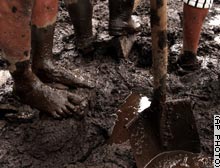 Mud is shoveled by villagers in the rescue effort in Panabaj, Guatemala, on Saturday.
RELATEDSPECIAL REPORT
• Interactive: Safety Tips
• Gallery: Top 10 worst hurricanes
• Flash: How hurricanes form
• Gallery: Saffir-Simpson scale
YOUR E-MAIL ALERTSSANTIAGO ATITLAN, Guatemala (AP) -- Dozens of Mayan Indians dug through congealed mud with hand tools Saturday, searching for bodies under a landslide in Guatemala that swallowed an entire neighborhood. Many of the dead were buried without identification, as the death toll from a week of relentless rains across Central America and Mexico rose to 613 victims. Hardest hit was this lakeside town, where the side of a volcano collapsed, killing at least 208 people. Federal officials said Saturday the victims were among 508 people killed and another 337 missing in Guatemala. The rest of the dead were scattered throughout El Salvador, Mexico, Nicaragua, Honduras and Costa Rica. The mud-spattered body of 3-year-old Mari Taxachoy Tzina was pulled Saturday from the home where she died. Her father, Gaspar, buried her in a common grave at the local cemetery. "That's my wife, my two daughters, my son -- I'm only missing one more son," he said, explaining how he had buried almost his entire family. "You always think about saving your family, but I couldn't," said Gaspar, a laborer who returned to his home town from work in Guatemala City to find his house gone, replaced by a blank face of mud. Guatemala has suffered the brunt of heavy rains exacerbated by Hurricane Stan, which made landfall Tuesday on the Mexican Gulf Coast before quickly weakening to a tropical depression. Governments in Central America and Mexico were still struggling Saturday to reach isolated areas devastated by flooding and landslides. Many roads had yet to be cleared of debris. Primitive wooden coffins pile upOn the banks of Lake Atitlan, dozens of Mayan Indians swarmed over a vast bed of caked mud that covered trees and houses, looking for those still missing. Primitive wooden coffins piled up in the cemetery, waiting for badly decomposed bodies. Villagers held sprigs of native herbs to ward off odors as they dug mass graves for bodies that likely would be buried without names. "Entire families have disappeared," said Diego Sojuel, of the Santiago Atitlan municipal aid committee. "In some cases, there is no one that can identify the cadavers. And in other cases, it is because of the state of decomposition that we are going to have to bury them without names." Tourists worked alongside local residents digging trenches 3-meters (10-feet) deep through mud strewn with bits of tin roofing, clothing, papers and bedding. Chris Needham, 24, of London, paused to wonder aloud whether some areas might eventually have to be declared a burial ground. "That's people's families under there," he said. "They're not going to stop digging. I wouldn't stop." Guatemalan officials organized an air-rescue squad of their own helicopters as well as those lent by the United States and neighboring Mexico. But bad weather has limited flights. Colombia announced Saturday it will fly in 10 tons of food, cleaning materials and first-aid equipment to help victims in Central America and Mexico. In Mexico, President Vicente Fox visited devastated southern Chiapas state and delivered aid to hundreds living in shelters. Some victims said they still hadn't heard from missing family members. "I want them to look for my brother, Leonardo Maldonado, who is 27. He lives with us, but he went to work and I haven't heard anything from him," said evacuee Maria del Carmen. 'Thunderous roar of mud'In Guatemala, government workers have used heavy machinery to clear fallen trees and earth from the InterAmerican Highway. The country's important Pacific coast highway remained impassable, however, after raging rivers destroyed five bridges. The disaster started gradually in communities ringing Lake Atitlan, where creeks and rivers began spilling their banks on Wednesday as rains soaked cornfields that climb steep, deforested hillsides. Farmer Martin Ramirez Tacaxoy, 41, said his sister came by to wake him up to tell him the nearby river was rising. But because the continuing rains had been so gentle, many other people went back to sleep -- until the wall of earth came. "It was a roar, it was like an earthquake," said Ramirez Tacaxoy, who pulled out three of his neighbors, some severally wounded from mud that had buried them, in some cases up to their necks. "Some people on the edges where able to grab hold of coffee trees, and we pulled them out. But many remained underneath." Survivors struggled to describe the thunderous roar of the mud that buried entire families. "I saw it coming. I leaned up against the wall," Pablo Gaspar, 16, a firewood collector, gasped on his hospital bed after being rescued from the muck. "Then the wall collapsed on me." He lost six family members, including both his parents. Copyright 2005 The Associated Press. All rights reserved.This material may not be published, broadcast, rewritten, or redistributed. 
|
 | ||||||||||||||||||||||||||||||||||
 |
|
| © 2005 Cable News Network LP, LLLP. A Time Warner Company. All Rights Reserved. Terms under which this service is provided to you. Read our privacy guidelines. Contact us. |
|