
 |
|
|||
| Member Services |  |
|||

 |
 |
 |

   | 
| ||||||||||||||||||||||||||||||||||||||||||||||
Eritrean bid to halt deforestation
Monday, October 24, 2005; Posted: 7:41 a.m. EDT (11:41 GMT)
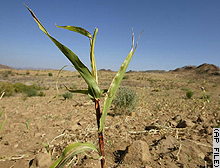 Some 95 percent of Eritrea's forests have been lost to desertification in the past century. READ MORE STORIES
LIFE-CHANGING TECH
YOUR E-MAIL ALERTSKEREN, Eritrea (Reuters) -- Seyoum Goitom, inventor and father-of-six, stood in his workshop in Eritrea, explaining his passion for mechanics, while young girls herded goats outside and butterflies wobbled in the warmth. Goitom has so far built a biscuit maker, welding machine and lawnmower from recycled parts. Now he is looking at a much bigger and possibly more significant project. The 38-year-old is turning his creative energies to deforestation around Keren, his home and one of Eritrea's most attractive towns, where the forest is slowly disappearing. He is working on an enormous, solar-powered cooker based on a satellite dish which he believes could drastically cut the need for firewood among his compatriots in the Red Sea state. Some 95 percent of Eritrea's forests have been lost in the past century because of drought, a growing population and -- to a lesser extent -- the war for independence from Ethiopia when many trees were cut to deny hiding places to combatants. "When I was young, we could find big, old trees in the mountains and a small stream at the bottom all year round," Goitom said, standing on a dry slope. "Now the river is dry, and there are almost no trees. They have been cut for fuel and building," he added, as two young boys ambled past, looking for firewood with axes in their hands. Deforestation is a major threat to Africa's vulnerable communities. An international report said earlier this year that desertification, caused in part by widespread deforestation, threatens to drive millions from their homes. Goitom thinks he can make a difference. "Our country is becoming a desert," he said. "If we use solar (power), the environment will be OK. My children will be healthy and happy and better." The inventor has received some financial support from the Dutch Embassy and is hoping to win backing from other groups in order to make his solar-powered cooker available to schools and other public organizations. "I'm using this old satellite dish, and converting it to a cooker," he said. "The schools use wood for cooking. If they have a solar cooker, then we can save on wood." The satellite dish measures 6.5 feet (2 meters) in diameter. Running his hands over the tin foil that covers the dish, Goitom explains how the direction and angle can be adjusted to cook wherever the sun is shining. "We are trying a pilot project. If it is successful, then we will produce more (solar-powered cookers)," he said. Necessity is the mother of invention in Eritrea, where roughly two-thirds of the population of 3.6 million require food aid this year. Like Goitom, many people learn to harvest what they can from the harsh environment to survive. In Arberebo, in the mountains outside Asmara, children pick succulent prickly pears, or beles, from cactuses and sell them. The fruit can grow in harsh climates and even on dry stone walls, making it well-suited to Eritrea's drought-prone climate. Perhaps more importantly, the beles season runs from June to October, the hunger season when the previous year's harvest has run out and the next one is not due for several months. "We sell it," says Marta Deriba, 15, smothering the kiwi-shaped fruit with an old tin can on the end of a stick. With a flick of her wrist, she twists the stick and tears the beles off the cactus. "Then with the money, we buy our clothes and our shoes. We also buy pens and exercise books, and we also help our parents." Donkeys and camels shuffle into Asmara's Medeba market every morning bearing wooden boxes full of beles. Idris Ali, 16, gets up at 3 am every morning for the three-hour trek to the market. "(The fruit) creates job opportunities for the kids, who cannot otherwise find any work especially during summer," he said. "I don't have to depend on my parents. I can buy anything I need for myself." Goitom, the inventor, recognizes this need to improvise and use what is available to improve one's life. "When there are no spare parts, you have to be more clever," he said. "(You become) more interested in modification." Looking around at his tools, old generators, engines, and motorbike parts strewn randomly on his workshop's dirty floor, he recalls how he developed his passion for gadgets. "I used to go to my father's workshop every day to help him," he said, describing his first attempts as a 10-year-old to repair broken radios and water pumps. "Little by little, I became more and more interested in technical things." News from the outside world has also fired his ambitions. "I heard that in Europe, they are using some kind of gas to power cars. I would like to convert my Lada," he mused, while driving back to the workshop in his 1964 model. Copyright 2005 Reuters. All rights reserved.This material may not be published, broadcast, rewritten, or redistributed. 
|

| ||||||||||||||||||||||||||||||||||||||||||||||
 |
|
| © 2005 Cable News Network LP, LLLP. A Time Warner Company. All Rights Reserved. Terms under which this service is provided to you. Read our privacy guidelines. Contact us. |
|














