
 |
|
|||
| Member Center: Sign In | Register |  |
|||
 |
 |
 |
    | 
| ||||||||||||||||||||||||||||||||
APEC highlights contrasting Koreas
Wednesday, November 16, 2005; Posted: 8:08 p.m. EST (01:08 GMT)
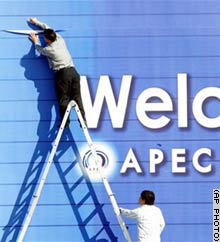 South Korea wants to become an Asian regional economic hub. 

RELATEDSPECIAL REPORT
• Timeline: Nuclear development
• Gallery: Key players
YOUR E-MAIL ALERTSBUSAN, South Korea (AP) -- The Asia-Pacific summit offers South Korea a chance to showcase its humming economy, high-tech innovations and vibrant democracy. It also highlights the gulf with its poor, isolated neighbor: North Korea. For years, South Korea staged major events, raising its international profile as host of the 1988 Olympic Games and 2000 Asia-Europe summit and co-host of the 2002 World Cup soccer finals. It set aside its dictatorial past in favor of democratic reforms and built one of the world's biggest economies from the ashes of the 1950-53 Korean War. This week, South Korea hosts the Asia Pacific Economic Cooperation forum, a gathering of leaders from China, Japan, the United States and 18 other Pacific Rim nations. Thousands of delegates -- none from North Korea -- have converged in the bustling city of Busan, one of the world's busiest ports. "World Best," boast signs in one Busan shipyard. The city's confident mayor said Busan would bid to host the Summer Olympics in 2020. APEC delegates file into a vast glass-and-steel conference center called Bexco, where South Korean companies display robots, wireless Internet and huge television screens. By contrast, North Korea has barely changed in decades. The government of Kim Jong Il tightly restricts access for foreigners and the movements of its own citizens. Food and fuel are scarce, and infrastructure is dilapidated. Even the streets of its showcase capital, Pyongyang, are virtually empty of traffic. Defectors say torture and summary execution are common. While North Korea is absent from APEC talks, South Korea views North Korea's isolation as a major obstacle to the goal of APEC members to develop economic ties in the region, including road and rail links that could ferry goods across the Korean Peninsula and onto Europe. South Korea is promoting a joint economic zone in the North Korean city of Kaesong. "South Korea wants to move from Cold War outpost to the position of economic and regional hub, and for many, the first step is overcoming economic and political divisions between North and South Korea," said Scott Snyder, a North Korea expert. Once in a while, North Korea invites small groups of South Korean and other tourists to attend choreographed performances by tens of thousands of North Korean gymnasts and soldiers who pay tribute to Kim, a reclusive dictator who enjoys a state-sponsored personality cult. The North Korean tourist circuit also includes massive statues and luminous portraits of Kim's father and national founder, Kim Il Sung, and other monuments to a system of government that has produced a dire human rights record and, by its own account, nuclear weapons. China is North Korea's lifeline in the region, but old communist loyalties scarcely match the tangible fruits of Beijing's trade ties with its former battlefield foe, South Korea. The international dispute over North Korea's nuclear programs mean the North has little chance for now of shaking off its image as a dangerous pariah. Kim Jong Il rarely meets foreign dignitaries or travels abroad. State media document his morale-boosting visits to farms and combat units, and photographs usually show him in an anorak surrounded by elderly military officers in saucer hats. Kim's voice is never heard on radio or television broadcasts, possibly to preserve an aura of mystery and dignity befitting his state-sanctioned stature as a god-like leader. In Seoul this week, South Korean President Roh Moo-hyun greeted Britain's Prince Andrew and Chinese President Hu Jintao. On Thursday, he'll host President Bush for bilateral talks in the historic city of Gyeongju. On Friday and Saturday, he'll entertain Bush, Chinese President Hu Jintao, Japanese Prime Minister Junichiro Koizumi and other leaders at a dome-shaped villa in Busan called Nurimaru, or "Pinnacle of the world." North Korea sends messages to the outside world in English-language dispatches on KCNA, a state-run news agency that on Wednesday carried a report denouncing U.S. democracy as corrupt. "A duck in a swamp can become (U.S.) president if it has money," the report said. At one time, North Korea seemed to be stronger than South Korea. After the Korean War, North Korea quickly rebuilt its industrial base. But bad management spurred decay, and U.S.-backed, capitalist South Korea surged ahead economically. The North lost aid and allies after the Berlin Wall came down, and plunged into famine in the mid-1990s. Based in Seoul, the privately owned Korea Business Review describes business opportunities in North Korea. But a Korean proverb in its November edition seemed apt: "He signals with his eyes to a blind man, and whispers to a deaf-mute." According to the review, the proverb means: "Utter futility." Copyright 2005 The Associated Press. All rights reserved.This material may not be published, broadcast, rewritten, or redistributed. 
|
 | ||||||||||||||||||||||||||||||||
 |
|
| © 2005 Cable News Network LP, LLLP. A Time Warner Company. All Rights Reserved. Terms under which this service is provided to you. Read our privacy guidelines. Contact us. |
|













