
 |
|
|||
| Member Center: Sign In | Register |  |
|||
 |
 |
 |

   | 
| ||||||||||||||||||||||||||||||||
Nun a 'prison angel' for inmatesAmerican abandoned life of luxury for work in jail
Monday, December 26, 2005; Posted: 2:22 p.m. EST (19:22 GMT)
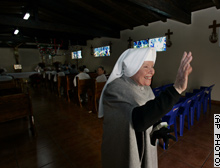 Sister Antonia Brenner leaves the chapel at the La Mesa State Penitentiary after counseling prisoners. 

YOUR E-MAIL ALERTSTIJUANA, Mexico (AP) -- The cell at the end of the dark hallway barely fits a cot, a desk and a folding chair. Still, this is home for Sister Antonia Brenner, an American nun who was raised in Beverly Hills, California, but abandoned a life of privilege to live in a notorious Mexican jail. Her neighbors are no longer Hollywood stars, but murderers, drug runners and human smugglers. They know her as "angel de la carcel" -- the "prison angel." Brenner, 79, looks puzzled when asked what motivated her riches-to-rags choice nearly 30 years ago. "I don't understand why people are so amazed," she says. "To give help is easy. To ask for it is hard." Just 5 feet 2 inches tall but crackling with energy, Brenner holds counseling sessions and does countless small tasks on behalf of the 7,100 inmates at La Mesa State Penitentiary, across the U.S. border from San Diego, California. In come bandages, soap and medicine; out go messages to loved ones beyond the prison's high walls. Brenner has long been a caretaker -- she raised seven children. Then, at 50, she traded her dresses and a spacious home for a homemade habit and a prison where conditions have led to inmate riots -- including three that she helped quell. "I'm effective in riots because I'm not afraid; I just pray and walk into it," she said. "A woman in a white veil walks in, someone they know loves them. So silence comes, explanation comes and arms go down." Her work has been recognized in books and, this month, she was inducted into the Washington-based Hall of Fame for Caring Americans. Her admirers include not just inmates but wardens and guards, too. "Wardens come and go, and I will, too, but Mother Antonia will always be here," said Jose Francisco Jimenez Gomez, the warden. "She is like a ray of sunshine." The only sunlight in her tiny cell filters through two small windows with a view of a guard tower and a barbed wire fence. A white sheet serves as the door to a cramped bathroom with a cold-water shower. She walks through the prison with a beaming smile, waving at inmates and guards and kissing many on their cheeks. She address them as "mi hijo" -- "my son." "Everyone loves her," says Jose Luis Romero, who is serving 4 1/2 years for stealing a car. "You always feel better about yourself after seeing her." Brenner was born Mary Clarke in Los Angeles, California, the second of three children. Her father made a fortune selling office supplies to defense contractors during World War II. The family lived in Beverly Hills and had an 11-bedroom, ocean-view summer home in Laguna Beach, south of Los Angeles. Later, she moved to Ventura County, her last home before the prison. After two failed marriages, Brenner immersed herself in charity work and was deeply influenced by a Los Angeles priest named Anthony Brouwers. When she became a nun in 1977, 13 years after Brouwers died, she named herself Sister Antonia in his honor. Brenner first visited the prison in 1965 on a trip to deliver medicine and supplies to Tijuana hospitals. She moved in 12 years later, and her routine has changed little. She rises around 5 a.m. for prayer, then distributes prayer cards to inmates who are crammed inside a boxed chain-link fence waiting for a court appearance. She speaks four days a week at the prison's new church, an orange building with five rows of wooden benches and white plastic chairs. "Everything eventually ends -- your money, your sickness, your family, your time in jail," she tells about 20 inmates dressed in gray sweatsuits, speaking in flawless Spanish. "The only thing that won't end is Christ's love for you." From there, she walks the grounds, where a guard thanks her for finding a wheelchair for his grandmother, who died that morning. "She can talk to the prisoners in a way that the guards cannot," says Ulises Romero Rubio, a guard for 12 years. "She knows how to calm their nerves." Copyright 2005 The Associated Press. All rights reserved.This material may not be published, broadcast, rewritten, or redistributed. 
|

| ||||||||||||||||||||||||||||||||
 |
|
| © 2005 Cable News Network LP, LLLP. A Time Warner Company. All Rights Reserved. Terms under which this service is provided to you. Read our privacy guidelines. Contact us. |
|



















 External sites open in new window; not endorsed by CNN.com
 Pay service with live and archived video.

