|
|
New Media and Politics
|
GO |
|
|
New Media and Politics
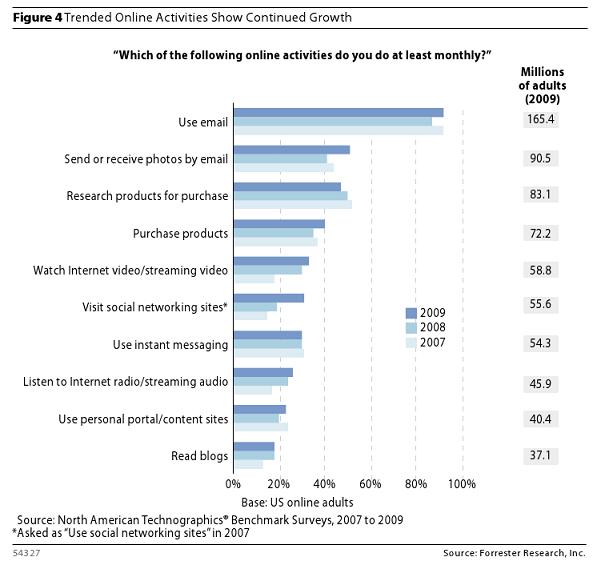
These are some of the new media, to the left, and these
are some of the numbers, below. Email is far ahead of other
forms of electronic communication with more than 80% of the
population now sending and receiving email messages, and buying
online is second. In the comparisons of 2007, 2008, and 2009 the
largest increase 2007 to 2008 was watching streaming video. The
YouTube 2008 presidential election campaign contributed more than
60 million views to that increase. The largest increase 2008 to
2009 was visiting social networks.
Changes in communication technology and practice are
happening so rapidly they leave our understanding far behind. The
changes in communication technology and patterns of use are
chronicled by many tech bloggers; a list is available
here. We know very little about how these new practices of
communication are becoming integrated into practices of politics.
This is where I am attempting to shed some light.
The new technologies of communication 'invading' our
politics are: blogging, video 'for the masses,' social networks,
and microblogging.
Microblogging -- Twitter being the most
important
There's
a hashtag for that is a collection of
microblogging streams about politics. At the moment the streams
disappear about as quickly as they appear. If you want to know
what they were microblogging about Obama being awarded the Nobel
Prize for Peace or the shooting at Fort Hood or any of the many
other events energizing twitterers someone needs to have captured
them and put them in an archive because they are gone. That is
what There's a hashtag for that is. It is an
archive of streams of microblogging about politics.
Video aggregation and distribution --
YouTube being the most important
The presidential election of 2008 was a watershed
for video/YouTube and politics. YouTube did not exist in 2004. In
2007/2008 there were thousands of videos and more than a hundred
million views.
Video
archive There is something of the same problem
for political videos as for streams of microblogging. All of the
candidates in the primaries of 2007 had a channel on YouTube where
you could find their videos. Then both the McCain and the Obama
campaigns -- along with Bob Barr and others -- had channels for
the 2008 election. The only one left is The Obama campaign videos.
The rest have disappeared; they are no longer accessible as
YouTube channels. So we need an archive. The Digital Library of
the University of Iowa and I have put together an archive of all
of the videos of four of the Democratic candidates and four of the
Republican candidates for the primaries. In addition we have the
videos of the McCain and the Barr campaigns.
The Obama White House is also using YouTube to
distribute videos of their activities. Those have not begun to
disappear. So no archival activity is necessary at this point.
Thinking outloud about these new
opportunities for communication
I did two analyses based on campaigns in the
primary and a series of a dozen analyses of the fall election
campaign.
And I have just started on microblogging.
|
New Media and Politics --
Research Reports |
|
New Media |
Report |
| spying |
Reframing the argument -- how many nations do you want following your electronic communication? |
| twitter |
Politics on Twitter: Hashtags, Retweets, Urls |
| twitter |
Mr. Erdogan gets and earful -- global communication |
| twitter |
#BenghaziInFourWords and the Twitter echo chamber |
| twitter |
Focus -- concentration or dispersed -- in streams of Twitter messages |
| twitter |
Probably not a social movement |
twitter
|
A
Moment in the Constitution of Social Movements |
twitter
|
Race
ace? UK and US consider constitutional changes |
| twitter |
The
highpoint of global communication as Egyptians struggle |
| twitter |
Morsi
and global communication November 23 to December 2 |
| twitter |
What?
A new dictator in Egypt? |
| twitter |
It's
a global shoutout Mr. President |
| twitter |
The
Reach of Politics via Twitter -- Can that be real? |
| twitter |
How
many people does it take to produce 700,000 messages
posted to Twitter? |
| twitter |
Really
big Twitter numbers: the flow of commotion/communication |
| twitter |
The
reach of This seat's taken |
| public opinion |
Consequences
of lying -- Obama vs Obama |
| twitter |
Mass
Murder and the Social Construction of Terrorism |
| twitter |
Hijacking
the Romney Search |
| twitter |
Supreme
Court and Health Care; Tracking the focus of attention |
| twitter |
Celebrating
the defeat of ACTA |
| twitter |
It's
Still Obama vs Obama |
| twitter |
Update:
Obama vs Obama, 6/01 through 6/10 |
| twitter |
Obama
vs Obama, the one person election |
| twitter |
Reframing
Audience; Co-motion at #SOTU |
| twitter |
Political
Organizations and the Magic of Retweeting |
| twitter |
Shouting
across divides |
| twitter |
Arab
Spring From the Ground Up |
| twitter |
Triggers
and Surges |
| twitter |
Tracking
me; tracking you -- This says it all |
| twitter |
Iran
on Twitter, but why not Facebook? |
| twitter |
This
is epic. Protesters in Tahrir . . . |
| twitter |
The
Many Voices of ACTA |
| twitter |
What
they had to say |
| twitter |
What we
want to know -- on engineering communication |
| blogging |
An
Invitation to Blog |
| twitter |
The
4:00 p.m. news |
| twitter |
The
Huntsman surge |
| twitter |
Katy
versus Rick -- and the winning Perry is . . . |
| twitter |
The
big day in Iowa -- January 3, 2012 |
| twitter |
The
final push -- penultimate tweeting |
| twitter |
How
do you know you are winning? -- Three and one-half months
|
| twitter |
The
final push -- happy new year |
| twitter |
The
final push -- who is getting the attention? |
| twitter |
The 'We
Move' in #Occupy . . . |
| twitter |
Retweeting
in big numbers |
| twitter |
How
you know you are winning -- When a judge speaks |
| twitter |
Celebrating
two months |
| twitter |
One
more time Oakland becomes the center of the Occupy
movement |
| twitter |
Gingrich
and Perry struggle |
| twitter |
One
more time Oakland becomes the center of the Occupy
movement |
| twitter |
Stability
-- though at different baseline levels -- Gingrich and Ron
Paul September-October 2011 |
| twitter |
Growth
and no Growth -- Twitter messaging Cain-Gingrich
September-October 2011 |
| twitter |
The
Crossing Pattern -- Twitter Messages Bachmann-Cain
September-October 2011 |
| twitter |
When
they back down -- That's when #3 |
| twitter |
How
do you know you are #winning? |
| twitter |
How
do you know you are winning? |
| twitter |
Noticing
Identity in Social Movements -- #OccupyWallStreet |
| twitter |
The
Medium is the Message or Something Like That |
| twitter |
A
Day of Protest |
| twitter |
COP16
Was a Focused Community and How One Can Know |
| twitter |
#AttackWatch
-- There is no monopoly control when it comes to hashtags |
| twitter |
The News Move
in Twitter Messaging |
| twitter |
The
language of threat in our political discourse |
| twitter |
#TellBashar2Go |
| twitter |
Twitter
and the Inception of Political Revolts |
| twitter |
Bachmann
versus Palin -- who really cares? |
| twitter |
The president spoke and this
is what they said |
| twitter |
Arab
spring from the ground up |
| twitter |
The
State of the Union Address -- It's a happening |
| twitter |
Evoking Latent Dispositions:
How Americans Came to Believe Obama Is a Muslim |
| twitter |
RT
@bobboynton new media and the revolting middle east |
| twitter |
Now that's going viral:
#ScariestWordsEver "President Palin" |
| twitter |
Tweeting
blood libel -- a visual analysis |
| twitter |
#teaparty
-- they talk a lot |
| twitter |
The
Twitter Two Step -- Reach of New Media and TV |
| twitter |
Going
Viral -- in the small |
| twitter |
You
Can't Stomp on Us -- after a Rand Paul organizer did stomp |
| twitter |
The
evil twins of global popular culture: bin Laden and Hitler |
| twitter |
"Obama
muslim" retweeting and more OR retweeting is just the
start |
| twitter |
Audience:
the reach of political messaging on Twitter |
| twitter |
Members
of Congress are not harnessing the communicative power of
Twitter |
| twitter |
#twitterfacts
is discovered |
| twitter |
COP15 --
Voice |
| twitter |
Cat
Bin Lady |
| twitter |
Opinion
Leadership From Inside the Beltway |
| twitter |
Opinion
Leadership: Outside the Beltway |
| twitter |
Micro
Spin and the Obama Administration |
| twitter |
The
Bin Laden Joke Stream |
| twitter |
Two
Structures: Times Square and #Teaparty |
| twitter |
Assessing
Volatility |
| twitter |
Politics
Moves to Twitter: How Big is Big and Other Such
Distributions |
| youtube |
The
White House Channel on YouTube and Health Care Reform |
| twitter |
Open
mouth and spark a spike or Osama bin Laden wanted dead or
alive |
| twitter |
Sarah
Palin did what? The importance of redundancy |
| twitter |
#HCR
The Argument Joined |
| twitter |
Bin
Laden as Global Celebrity |
| both |
Global
Communication Reconfiguring Power |
| twitter |
Twenty-four
Hours Tweeting the State of the Union |
| twitter |
That
was fast! Twitter and hot political news |
| twitter |
What
is one tweet worth? |
| twitter |
The
difference an announcement can make |
| twitter |
How
big is big? And why would one be interested? |
| twitter |
North
Korea did what? Dynamics of Attention |
| twitter |
News
as Urumqi; how to understand what 'the news' has been and
is becoming |
| twitter |
North
Korea did what? Dynamics of Attention, ITP newsletter |
| youtube |
What
if you had a choice?, presented 2009 APSA meeting |
| youtube |
The
public face of transparency, Communication section
preconference APSA 2009 |